Airlines & airports welcome clarity from European Commission that flights would continue under ‘no deal’ Brexit scenario

Commenting on the European Commission publishing guidance confirming that flights between the UK and EU would continue in the event of a ‘no deal’ Brexit scenario, Tim Alderslade, Chief Executive of Airlines UK, and Karen Dee, Chief Executive of the Airport Operators Association, said:

“We welcome that the European Commission has joined the UK Government in providing further reassurance to passengers and businesses that flights will continue whatever happens over the coming weeks.

“That said, a comprehensive bilateral air services agreement between the UK and EU remains the best way to protect market access post-Brexit and is clearly in the interests of both sides.”

Airside licensing needed at airports to curb rising disruptive passenger incidents

Organisations from across the aviation and tourism sectors have come together to call for the Government to amend the Licensing Act so that it in future applies to bars, pubs, restaurants and retail outlets selling alcohol airside at airports, in an order to help curb the growing number of disruptive passenger incidents across the UK. The statement comes in response to a Government Call for Evidence that was published on the issue today.    

Organisations calling for the exemption to be removed include Airlines UK, the trade association for UK airlines that represents 13 UK carriers; the Airport Services Association (ASA), which represents the interests of the global aviation ground services community at more than 250 airports; the British Airline Pilots’ Association (BALPA) which represents over 85% of all commercial pilots in the UK; Unite the Union, the largest body in UK civil aviation covering individual members; ERA (European Regions Airline Association), representing European aviation including 50 airlines; and ABTA – The Travel Association, the leading association of travel agents and tour operators.

Tim Alderslade, Chief Executive of Airlines UK, the trade association for UK airlines, said: 

“The problem of disruptive behaviour has got progressively worse over a number of years, despite the best efforts of industry to tackle it. There is no evidence to suggest these incidents won’t persist without the active involvement of Government.

 “Alcohol plays a major role in disruptive passenger incidents and so it is essential that its sale in airports is done responsibly. We do not want to stop passengers from enjoying a well-deserved drink in the airport and removing this unnecessary exemption will not do that. It will simply ensure that the same standards of responsible alcohol sale that any bar, pub or shop on the high street must follow are also applied to outlets airside.”

The Baroness McIntosh of Pickering, Chairman of the House of Lords Select Committee on the Licensing Act 2003, which published a report on the Licensing Act in 2017 advocating the change, said:

The Committee concluded that there is simply no justification for the Licensing Act not to apply to sales airside at airports. Our report showed that removing the exemption can be done quickly and so with alcohol related disruptive passenger incidents continuing, the Government must take this action immediately.”

 Mark Tanzer, Chief Executive of ABTA – The Travel Association, said: 

‘’Disruptive passenger incidents are thankfully rare, but when they occur these incidents can have a serious impact on crew and other passengers. With alcohol a major causal factor in such incidents, we support measures to ensure that its sale in airports is done responsibly. Proportionate licensing can be part of the solution, whilst having no impact on the vast majority of travellers who enjoy a drink responsibly before their trip.”

 Jon Conway, Director General of the Airport Services Association, said: 

“It is unacceptable when passengers and staff at the airport suffer because of an intoxicated minority. Although industry is working hard to tackle the issue of disruptive passengers collectively, Government can and should assist these efforts by removing this outdated exemption.”

Brian Strutton, General Secretary of the British Airline Pilots’ Association (BALPA), said: 

“Excessive alcohol consumption and disruptive behaviour is a growing concern and beyond the potential threat they cause to the safety of the aircraft, air crew should not be expected to deal with violent or abusive passengers.

 “We do not want to prevent passengers from enjoying a drink in the airport – we simply believe that alcohol sold in the airport should be done responsibly and excessive consumption not encouraged. Removing the exemption would do just that.”

 Montserrat Barriga, Director General of ERA (European Regions Airline Association), said: 

“Modern day air travel is now very accessible with more people flying than ever before. However, the industry has seen an increase in disruptive passenger behaviour, with most cases being the result of excessive alcohol consumption. 

 “Such behaviour has the potential to impact on both the safety and security of an aircraft and should not be tolerated. Although airlines monitor and counteract such behaviour with specific cabin crew training, the airports also have a role to play in ensuring such instances of disruptive behaviour are mitigated prior to a passenger boarding the aircraft, including the responsible sale of alcohol at the airport outlets.

 “ERA supports the removal of this unnecessary exemption, which we believe will improve standards of safety and security whilst still affording passengers the opportunity to drink responsibly before boarding their flight.”

Oliver Richardson, National Officer, Civil Air Transport from Unite the Union, said:

“Air crew and airport staff should not have to suffer from verbal or even physical abuse at their workplace from an intoxicated few. Airside bars, pubs and retailers must be held to the same standards as outlets in our towns and cities, to ensure that excessive alcohol consumption is not encouraged.”

Vacancy – Public Affairs & Policy Executive / Manager (depending upon experience)

Airlines UK (AUK) is looking for a motivated and hard-working Public Affairs & Policy Executive / Manager (based on experience) to join its team in London. The successful candidate will assist with policy campaigns and help to formulate AUK policy on behalf of airline members, and work with colleagues in advocating our messaging to stakeholders including Ministers, parliamentarians, regulators and industry bodies, ensuring that their interests are effectively represented and that the voice of AUK is heard in Westminster and the devolved administrations. S/he will report to the Policy & Public Affairs Director.

 Job Requirements

  • Exceptional communicator (oral and written) with a proven ability to work independently on policy research and analysis, develop messaging across a range of policy interests, and experience of putting in place advocacy and engagement strategies.
  • A track record of engaging with and working alongside stakeholders on policy, legislation, consultations and research projects.
  • Excellent knowledge of UK Government and parliamentary institutions.
  • Skilled organiser, capable of managing a challenging agenda with competing priorities.
  • At least a basic understanding of the aviation industry and airline sector, in particular.

 Job description – the selected candidate will:

  • Work in a small, dynamic and hardworking team in central London.
  • Be uniquely involved with the UK aviation industry and airline sector in particular, working on issues including Brexit, aviation tax, airport expansion, disruptive passengers, sustainability, the upcoming Government Aviation Strategy and consumer protection policy.
  • Contribute to the visibility and reputation of the airline sector within the UK policy landscape.
  • Help to manage policy campaigns in line with agreed AUK priorities and objectives.
  • Interact closely with the 13 AUK airline members.
  • Help to co-ordinate the work of assigned AUK Policy Working Groups.
  • Develop a personal reputation as a policy expert within aviation, speaking at meetings / roundtables and advocating publicly on behalf of agreed AUK positions. 

 Salary: Competitive but based upon experience. 

 If you are interested in this position, please apply by sending your CV and covering letter to [email protected].


Air Passenger Duty increase demonstrates that Government’s words on ‘Global Britain’ are not matched by their actions

Responding to the announcement in the Budget that long-haul Air Passenger Duty rates will rise with inflation from 2020, Tim Alderslade, Chief Executive of Airlines UK, said:

“Today’s announcement sends entirely the wrong signal as we prepare to leave the European Union.  APD is nothing but a tax on Global Britain.  Rates are already the highest in the world, with the burden on passengers travelling from and within the UK having risen over 1000% since its introduction, and set to hit an eye watering £4bn by 2022/3.  

 The UK was only country in Europe to see a loss of direct connectivity last year, and today’s increase on business and holiday travellers will make it even harder for UK airlines to grow our international connectivity, establish new trade links and encourage more tourists to visit the UK.  With Brexit just around the corner, it is a missed opportunity to have truly transformed the UK’s international competitiveness.

Ministers can talk all they like about reaching out to the world but today’s increase demonstrates that their words are not matched by their actions and will remain so until they get rid of this damaging tax”.

Budget announcement on ePassport gates a welcome step in the right direction

Responding to the announcement at the Budget that access to ePassport gates at the border at UK airports will be extended to visitors from the United States, Canada, Australia, New Zealand and Japan, Tim Alderslade, Chief Executive of Airlines UK, said:

“As passenger numbers continue to rise, UK Border Force must be adequately resourced and adopt new approaches in order to prevent a repeat of last summer, where lengthy border queues were experienced at a number of UK airports. This announcement is a welcome step in the right direction, enabling millions more travellers to be processed more quickly. It’s important now to ensure Government rapidly implements the required technical changes so passengers can take advantage as quickly as possible.” 

Airlines UK response to comments from the Scottish Conservatives on Air Departure Tax

Responding to comments from the Scottish Conservatives today on the need to reduce Air Departure Tax, Tim Alderslade, Chief Executive of Airlines UK, said:

“Aviation in Scotland is crying out for this cut and it is now up to both governments to bang some heads together and put an end to this legal wrangling. Action on APD would be the single best way to stimulate demand for new routes and boost connectivity to Scotland’s airports. We know that Scotland has lost some routes this year and it’s little surprise when you consider that passengers are charged up to £78 just to leave the country – it makes Scotland uncompetitive with the rest of Europe and with Brexit on the horizon it makes little sense when we need to be reaching out to the world now more than ever.”    

UK depends more on air freight services than most EU competitors

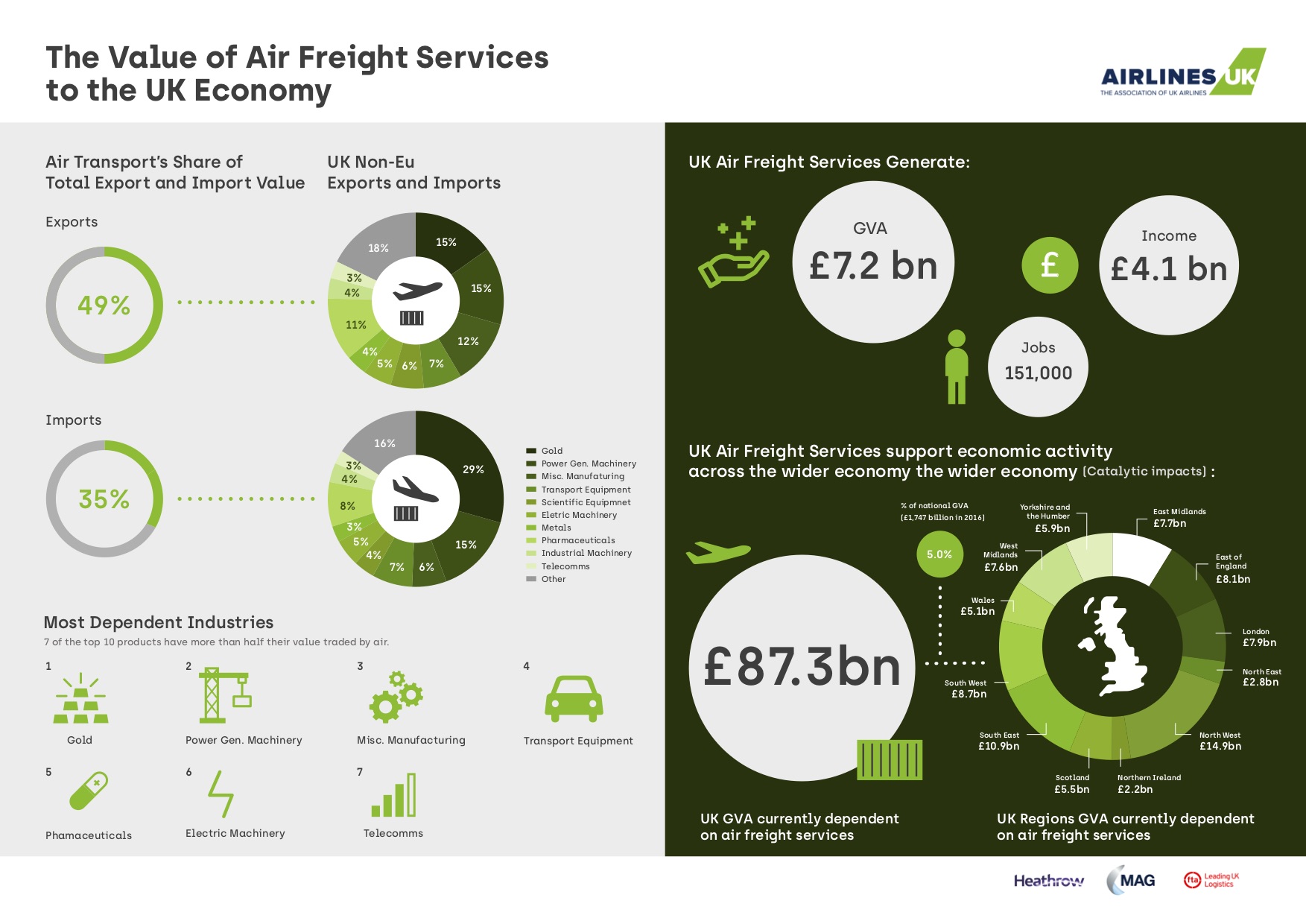
A major new report published today shows that the UK is more dependent on air freight services compared to most of its EU competitors.

The report, commissioned by Airlines UK and supported by Heathrow Airport, Manchester Airports Group and the Freight Transport Association, shows that while only a quarter of German exports to non-EU countries in value terms are transported by air, for UK exports it is nearly half.  Only Ireland ships a greater share of its non-EU exports by air than the UK.

The report calculated the total economic contribution of the air freight sector to the UK economy, and found:

  • UK air freight imports and exports were worth £181 billion in 2017
  • Air freight services contribute £7.2 billion to the UK economy and support 151,000 jobs
  • Critically, looking at air freight’s wider contribution to UK PLC, the study shows that across all sectors of the economy £87.3 billion of GVA is currently dependent on air freight exports, including a very significant proportion of some key industries’ output:
  • Pharmaceuticals – £13.9bn
  • Computer, electronic & optical – £8.3bn
  • Creative arts & entertainment – £5.3bn

The report also shows how vital air freight is to the UK’s regional economies. Whilst less than 2% of London’s production is dependent on air freight services, equivalent figures across some of the UK’s other regions include:

  • 9% in the North West (worth 14.9bn)
  • 8.6% in Wales
  • 7.6% in the East Midlands
  • 6.8% in the South West.

Air freight is essential to the transport equipment producing industries in the East Midlands, the North West, the South West and Wales, while pharmaceutical manufacturing in the North West makes very significant use of air freight.

Airlines UK Chief Executive, Tim Alderslade, said: “This report gives us the hard evidence of just how important air freight is to the national economy, our regional economies and to the international trade which will be increasingly important to us as we leave the EU.  The upcoming Aviation Strategy must look to how the UK can support its air freight sector thrive, both by creating the conditions to help grow our international connectivity, as well as by recognising where barriers exist and, in particular, the important role and contribution of Night Flights in facilitating cross-border trade”.

The report makes clear that there are real opportunities, particularly for regional airports, arising from improved air connectivity. It cites as an example the fact that the value of exports travelling to China from Manchester Airport has increased by nearly £300 million in the two years since a direct route to Beijing was introduced.

Making the link between connectivity and trade, the report cites how the UK has more freight capacity to the US than any other EU country, ensuring that last year 60% of the UK’s trade value with the US was transported by air (compared to 51% for France and 36% for Germany). By contrast, the UK currently has less capacity to China than either Germany or the Netherlands.

The report also provides a timely reminder of the damaging effects of Night Flight restrictions on UK competitiveness, since the express business model of the major international freight companies is increasingly dependent on being able to ship goods during the night, not least to meet growing consumer expectations of fast delivery.

Aviation Minister Baroness Sugg said: “Air freight is vital to the UK and global economy, delivering jobs across the country and transporting goods to people and businesses. I’m grateful for the work that Airlines UK does to promote the importance of the air freight sector to the UK and our Aviation Strategy will consider how best to support the future growth of this important industry in the UK.”

Lynne Embleton, Chief Executive, IAG Cargo, said: “Air freight is vital for the UK economy as this report demonstrates. The industry is built on speed and reliability – characteristics that helped IAG Cargo carry billions of pounds of UK exports and imports last year including life-saving drugs, fresh produce, essential tech and machinery parts. This supports a wide range of British businesses. As we prepare for Brexit, the Government’s Aviation Strategy must take the value of air freight to the UK economy into account and help the industry grow and further connect Britain to the wider world”.

Nick Platts, Head of Cargo, Heathrow, said: The UK has always been a great trading nation and Heathrow plays a unique role today in continuing that legacy. As the country’s most valuable port handling over £106bn of trade annually, Heathrow already connects Britain’s businesses with new customers in growing markets all around the world. Our expansion plans are on-track and will see us double our cargo capacity and add up to 40 new long-haul routes. But we can’t be complacent. Policymakers must not underestimate the competitive advantage of Britain’s air freight strength and ensure the right policies are in place that will enable us to keep Britain at the heart of the global economy.”

 Tim Hawkins, Chief Strategy Officer, Manchester Airports Group, said: “Air freight plays a critical role in supporting continued growth of the UK’s world class industries. The Government’s new Aviation Strategy is the opportunity to understand the future needs of these industries and the role that key strategic hubs across the UK can play in delivering a global trading network.

“The increasing range of ‘just in time’ express cargo services is appreciated by anyone ordering or sending a package via the internet, and airports like East Midlands and London Stansted have a vital role to play in keeping trade and e-commerce moving. At the same time, growth in long haul bellyhold cargo from airports like Manchester demonstrates there is huge opportunity to drive value directly into the UK’s regions.”

The full report is available here.

Airlines UK response to the publication of Civil Aviation Authority guidance on assisting passengers with hidden disabilities

Responding to the publication of Civil Aviation Authority guidance on assisting passengers with hidden disabilities, a spokesperson for Airlines UK, said:

“UK airlines have a proven track record of working to make air travel as accessible as possible. Airlines will engage closely with the CAA on this guidance and also actively promote the steps already in place to ensure passengers with any disability have the best experience when taking to the skies. The best thing a passenger with a hidden disability can do is pre-notify their airline in order to request additional assistance and make their individual needs known.”    

Advice to UK consumers impacted by Primera Air ceasing operations

Primera Air Scandinavia, a Danish scheduled air carrier, and Primera Air Nordic, a Latvian air carrier, which offered a number of services from Birmingham and Stansted to various points in Europe, Canada and the United States, have ceased to trade and suspended all operations with immediate effect.

Advice to UK consumers seeking information about refunds, travel insurance claims or ATOL protection: https://www.caa.co.uk/Passengers/Resolving-travel-problems/Travel-company-problems/Failure-of-scheduled-airlines/

We are aware of the following airlines offering Primera Air passengers rescue fares:

Norwegian

British Airways

Virgin Atlantic and Delta Air Lines

  • Routes available: Between London Heathrow and New York, Washington DC, Boston and Toronto
  • How to book: Call 0344 8747747 in the UK  or +1 800 862 8621 in the U.S
  • More details: https://www.virginatlantic.com/

Ryanair

easyJet

  • Routes available: routes previously operated by both Primera and easyJet
  • How to book: 0330 365 5000

Airlines UK response to publication of Government technical notices on Brexit and aviation

Responding to the publication of three Government technical notices on Brexit and aviation covering market access, safety and security, Tim Alderslade, Chief Executive of Airlines UK, said:

“Airlines are confident that there will be a new agreement on aviation between the UK and the EU. Whilst we don’t support a no-deal Brexit, we welcome that both the UK and the EU are proposing in this event a minimum agreement that would cover flight and safety requirements for the benefit of both passenger and cargo services.”