Airlines UK response to launch of consultations on airport development and airspace modernisation

Responding to the publication today of the Government’s draft Airports National Policy Statement along with a consultation on the modernisation of airspace, Tim Alderslade, Chief Executive of Airlines UK, the trade body for UK airlines, said:

“We welcome today’s announcement and the launch of these two important consultations by the Department for Transport. We and our member airlines will study the draft National Policy Statement, together with the associated documents and reports, over the coming weeks. Our members are however clear that the cost of expansion that they and their customers pay for is a key factor. Heathrow is the most expensive hub airport in the world – and airports are not funded by the taxpayer, but by passengers. Therefore any new infrastructure must be cost effective and affordable. The price paid by customers should not increase and today’s passengers must not pay for capacity that will not be operational until the mid-2020s.

“In short, we need the right solution at the right price, at the right time, in order to meet the needs of customers.”  

Commenting on the airspace consultation, he continued:

“Airspace modernisation is a critical, but sometimes overlooked part of our national infrastructure. The UK’s airspace system was created over 50 years ago when there were just half a million planes in the sky. It was never designed for the record number of aircraft, around 2.4 million in 2015, which now travel through it. We know that airspace redesign can present major challenges for airports, and good community engagement will be a vital part of the process. That said, to ensure capacity can keep pace with demand, airspace modernisation is urgently required and, without it, delays faced by passengers are likely to soar to 4 million minutes by 2030. 

“However, airspace modernisation wouldn’t just increase capacity and help prevent such sustained delays. Flying more direct routes will also reduce fuel consumption and lower CO2 emissions, lessoning aviation’s impact on the climate and local air quality – and in the process seeing a substantial reduction in aviation emissions.

“We therefore welcome today’s consultation and will study the proposals in detail.”

ENDS

UK Airlines response to Government plans for airspace modernisation programme

Responding to the speech delivered this evening at the Airlines UK Annual Dinner by the Secretary of State for Transport, Chris Grayling MP, which set out plans for the “biggest programme of UK airspace modernisation in half a century”, Tim Alderslade, Chief Executive of Airlines UK, said:

“Airspace modernisation is a critical, but sometimes overlooked part of our national infrastructure. The UK’s airspace was created over 50 years ago when there were just half a million planes in the sky. It was never designed for the record number of aircraft, around 2.4 million in 2015, which now travel through it. We know that airspace redesign can present major challenges for airports, and good community engagement will be a vital part of the process. That said, to ensure capacity can keep pace with demand, airspace modernisation is urgently required and, without it, delays faced by passengers are likely to soar to 4 million minutes by 2030.

 “However, airspace modernisation wouldn’t just increase capacity and help prevent such sustained delays. Flying more direct routes will also reduce fuel consumption and lower CO2 emissions, lessoning aviation’s impact on the climate and local air quality – and in the process seeing a substantial reduction in aviation emissions.”     

ENDS

Speech by Secretary of State for Transport at Airlines UK Annual Dinner

INTRODUCTION


Good evening.


It’s a pleasure to join you for tonight’s dinner.


It’s also a welcome opportunity for me to talk a little about the progress we’ve made on aviation during my first six months as Transport Secretary.


As many of you will know, this is a job that I’ve always wanted to do.


In my first six months I’ve already had the pleasure of meeting many people in this room, in what’s been a very exciting time for aviation.


One of my first acts as Secretary of State was to make a long awaited big decision: giving London City Airport the opportunity to expand.


And this is a government prepared to make other big decisions – including the location on aviation expansion in the south east, recommending a third runway at Heathrow.


More on that later.


BREXIT


Because I’d like to start by saying a few words about Brexit.


I understand that you are keen to hear exactly what Brexit will entail for the airline industry.


My priority right now is to secure the right deal for airlines following negotiations with the rest of the EU.


At the same time, I will be working alongside the Prime Minister and my colleagues in the Cabinet to provide as much clarity as possible, as early as possible.


It was in that spirit that Theresa May used her speech last week to make clear our intention to have an open trading relationship with the EU when we leave.


We will be pushing for a new, comprehensive, free trade agreement, giving us the best possible access to the single market.


We also want the best possible access to European aviation markets.


We believe it is in the EU’s interests to seek a liberal arrangement for aviation.


So that airlines can offer connectivity.


And passengers have choice.


Of course, the ultimate outcome for airlines – as for all areas of the economy – will have to await the conclusion of negotiations.


Yet as discussions with the EU proceed, I am confident that we will get what we need.


The fact remains that other countries want to do business with us.


That’s why among the major developed nations we have the world’s best performing economy.


And those nations want to do business with British airlines too.


Far from the gloomy forecasts that some economic commentators made in the summer, Britain ended last year as the strongest of the world’s advanced economies.


Growth didn’t just remain steady in the six months after the Brexit vote.


It accelerated.


Business activity hit a 17 month high in December.


Showing that confidence in our economy remains undiminished.


That’s because the June vote wasn’t just a vote to leave the  European Union.


It was also a positive expression of our desire as a country to raise our ambitions and look beyond the EU.


To strengthen our position as a global country.


With the global connections and gateways to make that possible.


And that is why we will also look to replace or amend our EU agreements with countries such as the US and Canada.


Aviation industry strength


In this all, the starting position of the aviation industry is one of great strength.


We already have the largest aviation network in Europe.


Direct services to over 370 destinations abroad.


Last year, BA added new routes to San Jose, Lima, Costa Rica, Santiago and Tehran.


Tui added new routes to Colombo in Sri Lanka, and Keflavik in Iceland.


And demand for flights continues to grow.


2015 was a record years for passengers.


And though we’re awaiting the final figures, the signs are that 2016 will break that record once more.


These passengers rely on an airline industry that is so often an exemplar of customer service.


Especially in the face of global events outside our control.


Last week the Foreign Office issued an alert about developments in the Gambia.


Within 72 hours, Thomas Cook had repatriated thousands of British holiday-makers – acting rapidly to do whatever was necessary to secure their safe return home.


With customer service like that, it’s no surprise that the aviation industry is confident about the future.


Over the next 20 years, the industry estimates a doubling of the world’s aircraft fleet.


That’s another 33,000 aircraft – quieter, cleaner, more efficient aircraft that can actually deliver a fall in carbon emissions.


In the summer, Virgin Atlantic made an early contribution toward that global fleet of new aircraft.


With a multi-billion pound order for 12 Airbus A350-1000 planes, powered by cleaner, quieter Rolls Royce engines.


And as the world increasingly embraces aviation in the coming decades, in return, aviation will increasingly drive the globalisation of trade and commerce.


Few other industries can predict future demand with such certainty.


So what we have to do – together – is make sure our aviation industry is ready to play its part in that growth.


A modern industry with 21st century systems and technologies.


An industry with the capacity to grow in a sustainable and responsible way.


An industry that provides British business with a foothold in emerging markets – as well as maintaining links to established markets.


These are our challenges for the future.


So we can prosper in a post-Brexit world.


Heathrow


That’s why in October we gave our backing to a third runway at Heathrow.


It shows that we are open for business, confident about who we are as a country, and ready to trade with the rest of the globe.


An expanded Heathrow will make possible an extra 260,000 aircraft movements a year.


Or 16 million additional long-haul seats by 2040.


And it will allow us to compete against European hubs such as Amsterdam, Paris and Frankfurt.


So we want to get the runway built as fast as possible.


And it will be subject to public consultation very soon.


We expect the National Policy Statement to pass through Parliament and be designated next winter.


Of course, the third runway at Heathrow is not just great news for Heathrow, but also for the rest of UK aviation.


Which is why most regional airports and airlines supported the decision.


But we’ve said that the runway must be delivered without hitting passengers in the pocket.


The Airports Commission is clear that this is achievable, as is the Civil Aviation Authority.


We’re not interested in expansion at any cost, but expansion at the right price.


So I expect the industry to work together to drive down costs for the benefit of passengers.


And the CAA is ready to ensure that new capacity fosters competition, keeping landing charges close to current levels.


I have full confidence in their ability to do so.


And at the same time, I expect the industry to commit to a world-class package of environmental and community mitigation measures for those living near the airport.


After all, a third runway will be an investment in our country’s future.


It will deliver major economic and strategic benefits to the UK.


New aviation strategy


Yet we’re not going to focus on a third runway at the expense of all the other challenges and opportunities facing the industry.


We are currently working on our new Aviation Strategy.


It’s a long-term framework covering airports, safety, security, competitiveness, consumers, regulation and capacity.


We’re focusing on issues where government can make a difference.


Where we can support the industry.


And we’ll stay clear of issues where we can’t.


It’s part of our plan to build on the momentum of the Heathrow decision – so the whole of Britain can benefit from new aviation capacity.


Airspace


And as the industry grows in the years ahead, we must make the best use of the assets available to us.


As airlines often point out, our airspace is one such asset: a critical piece of national infrastructure.


But like much of the rest of our infrastructure, it is increasingly congested and modernisation is overdue.


While modern aircraft are fitted with the latest satellite navigation technology, most of our airspace arrangements are half a century old.


I know how frustrated you and your passengers are by the delays this causes.


And I recognise the damage it does to your businesses.


Without action, flight delays will increase enormously in the next few years.


This wouldn’t just be damaging for passengers, but also for the economy and the environment.


That is why I am determined to address this challenge.


We will shortly be launching a consultation on measures to support airspace modernisation.


These measures will provide for the use of modern technology.


To reduce delays, cut noise for local communities, and lower carbon emissions


And speaking of carbon, last week I was pleased to see the release of your strategy, ‘Responding To The Carbon Challenge’.


It’s an important statement of all the industry is doing on carbon reduction.


And an indicator of the complex challenges created by the pace of change.


Conclusion


So together we have a lot of work to do.


Yes, we’re facing a time of adjustment and challenge.


But we’re also facing a time of extraordinary potential for this industry.


A chance for aviation to help make Brexit the success I know it will be, delivering the services and connections that will define our future outside the European Union.


I look forward to working with you to make that happen.


Thank you.

 

Chairman’s speech at Airlines UK Annual Dinner

My Lords, Secretaries of State, ladies and gentleman welcome to the 2017 Airlines UK Annual Dinner.

I would like to thank Venari Partners for generously supporting our event this year. I would like to extend my sincere thanks to the Secretary of State for Transport for joining us this evening and continuing the tradition of your predecessor, Sir Patrick who attended this event on several occasions

Before we hear from the Secretary of State, I would like to make a few remarks on our industry and our future prospects as we look ahead to the rest of 2017. In particular, I would like to reflect on the role our sector has to play in the post-Brexit Britain as outlined by the Prime Minister in her speech last week.

Listening to the Lancaster House speech it was the language on the United Kingdom’s new global approach that stood out. Terms such as, “more outward-looking” and ‘a truly Global Britain’ were used frequently. What struck me was how airlines are an embodiment of these characteristics, and therefore are an absolute vital component for any country looking for a more global future.

As a feature of everyday life, the sheer value, and for me the wonder of air travel is often lost. The fact that you can fly across the world in a day or to Europe for less than the cost of a short rail journey, raises few eyebrows these days. It’s therefore useful to remember the role airlines play as a key enabler of GDP, connecting all regions of the UK to countries across the world, including many of the important economies that, post-Brexit, the UK will be seeking closer ties with.

Thousands of British businesses rely on airlines to trade. Each year goods worth more than a £116 billion are flown by air from the UK to non-EU countries. This is a massive 35% of the value of all UK trade outside the EU. It is the connectivity provided by airlines that allows foreign business travellers to reach destinations across the UK, bringing vital foreign investment.

As an industry we are therefore uniquely placed to deliver the vision of a more outward-looking, global Britain.

However, there are obstacles to maximising this post Brexit opportunity so its in these areas we ask Government to work with us in creating the best environment for aviation growth in the UK.

As we all know Brexit itself has important consequences for the future of aviation. Leaving the EU will affect rights to travel not only between the UK and Europe, but also with other destinations, including the United States. Uniquely, aviation has an existing framework of agreements outside of the World Trade Organisation, that the EU and UK are both used to applying, allowing us to enter into liberal agreements with many non-EU states.  The UK and the EU have been leaders in opening up the air transport market, so we are looking to Government and its European counterparts to secure a deal safeguarding international market access for both sides. So far we have been encouraged by the dialogue and engagement we have had with Government since the vote in June.

Brexit apart, there is much to be done to ensure our aviation growth continues to the advantage of the wider UK economy. Even if everything goes smoothly, it will be many years before a new runway at Heathrow is operational and so the Government needs to take steps in encouraging airlines to develop new routes from other airports. Improving surface access to other airports around the country will enable catchment areas to be widened and make more UK routes competitive.

Air Passenger Duty remains a damaging tax on trade, tourism and investment. At a time when we are looking to strike deals and open up the UK to new markets and opportunities it is increasingly untenable to continue levying excessively high levels of taxation on air travel. The Scottish Government has acknowledged this and is reducing the tax by 50% from April next year. In order to eliminate concerns of the competitive distortion the Scottish reduction will create, the UK Government needs to reduce APD rates by at least an equivalent amount right across the UK.

We are looking forward to the imminent publication of the long-awaited consultation on airspace modernisation in the coming weeks, which we hope will demonstrate a much-needed recognition that capacity constraints in the sky can be just as damaging as those on the ground. We believe the time has come for the Government to join the sector in arguing the case for airspace modernisation so we can take advantage of the expected increases in passenger demand whilst reducing delays and delivering substantial improvements to the environment.

On the issue of sustainability, just last week Airlines UK produced a new report demonstrating the huge strides UK carriers have taken in reducing their impact on the environment. The results are truly impressive. Airlines have invested in more than 470 new aircraft since 2005, at a cost of over £37 billion, helping the industry to reduce its carbon emissions by 20 million tonnes and a further 400 aircraft are on order. Overall we are exceeding the industry target for improving our performance on carbon reduction, with an increase in fuel efficiency of 12% over the past decade. In short for the first time growth in UK aviation has been delivered without any increase in CO2 emissions.

Before I conclude I would just like to say a few words on the value of aviation beyond its vital economic contribution.

Tonight we should celebrate the size and success of our industry that punches well above its weight internationally. We have the third largest aviation market in the world and our airlines and airports are pioneers in their field, delivering unbeatable service and value to customers.

And lastly, something I think is frequently overlooked – we should celebrate aviation’s role as an enormously positive social and cultural enabler. For many hardworking families, our members make well deserved holidays possible. They allow distant friends to be reconnected, and reunites families otherwise separated by thousands of miles. Airlines enable people to broaden their horizons and enrich their lives.

UK Airlines are responding to the carbon challenge, new report concludes

Airlines UK, the trade body representing UK-registered airlines, has published a report which sets out how the industry can meet the UK’s demand for air travel, while ensuring it limits its environmental impact and hits its stringent targets on reducing emissions.

Tim Alderslade, Chief Executive of Airlines UK, said:

“UK airlines have invested in more than 470 new aircraft since 2005, at a cost of over £37 billion, helping the industry to reduce its carbon emissions by 20 million tonnes. A further 400 aircraft are on order and are due to enter into service in the coming years. Overall we are exceeding the industry target for improving our performance on carbon reduction, with an increase in fuel efficiency of 12% over the past decade. Government data shows that in 2015, jet fuel deliveries to UK airports, for UK and non-UK airline operations, were 10% lower than in 2006, despite 20 million more passengers being carried. In short, for the first time, growth in UK aviation has been delivered without any increase in CO2 emissions.    

“This report sets out in detail the carbon impact of UK aviation and what the industry is doing to deliver sustainable growth. It is clear that airlines are making enormous efforts to reduce their carbon emissions. Further work is needed – some of it requiring Government support – but the report demonstrates that the direction of travel is positive.”

The report details four pillars of work to help achieve the goal of carbon reduction. These pillars are the continued introduction of new aircraft; greater fuel efficiency; the use of sustainable fuels; and support for international carbon trading and offset schemes. The report considers each of these four areas in turn, explaining industry activity, progress and initiatives:

  • UK airlines have introduced more than 470 aircraft into service with orders placed for another 400. These new aircraft offer at least a 13% improvement in fuel efficiency.
  • Airlines, with their industry partners, are also working hard on other ways to create greater fuel efficiency. These initiatives include making aircraft fly more direct routes, with an uninterrupted climb and descent, whilst also having aircraft taxi on the ground without all their engines running. Filling each plane – using the right sized aircraft and utilising complex booking systems to ensure a high ‘load factor’ of passengers – also contributes to more efficient fuel consumption and lower CO2 emissions.
  • Sustainable aviation fuels, developed from waste produced from domestic, commercial and industrial processes, also offer opportunities. The Airlines UK report endorses the conclusions of the Sustainable Aviation ‘Sustainable Fuels Road Map’ (see here) and also welcomes the recent consultation by the UK Government on including sustainable aviation fuels in its updated renewable transport fuel policy.
  • Once all of the airline initiatives to cut CO2 emissions have been exhausted, some form of carbon offsetting scheme will still be required to meet lower CO2 emission goals. Globally, airlines now have a target to cut CO2 emissions from all journeys by 50% of their 2005 levels, by 2050. To achieve this, Governments, industry and civil society have worked with the International Civil Aviation Organisation (ICAO) to develop a carbon offsetting and reduction scheme for international aviation.

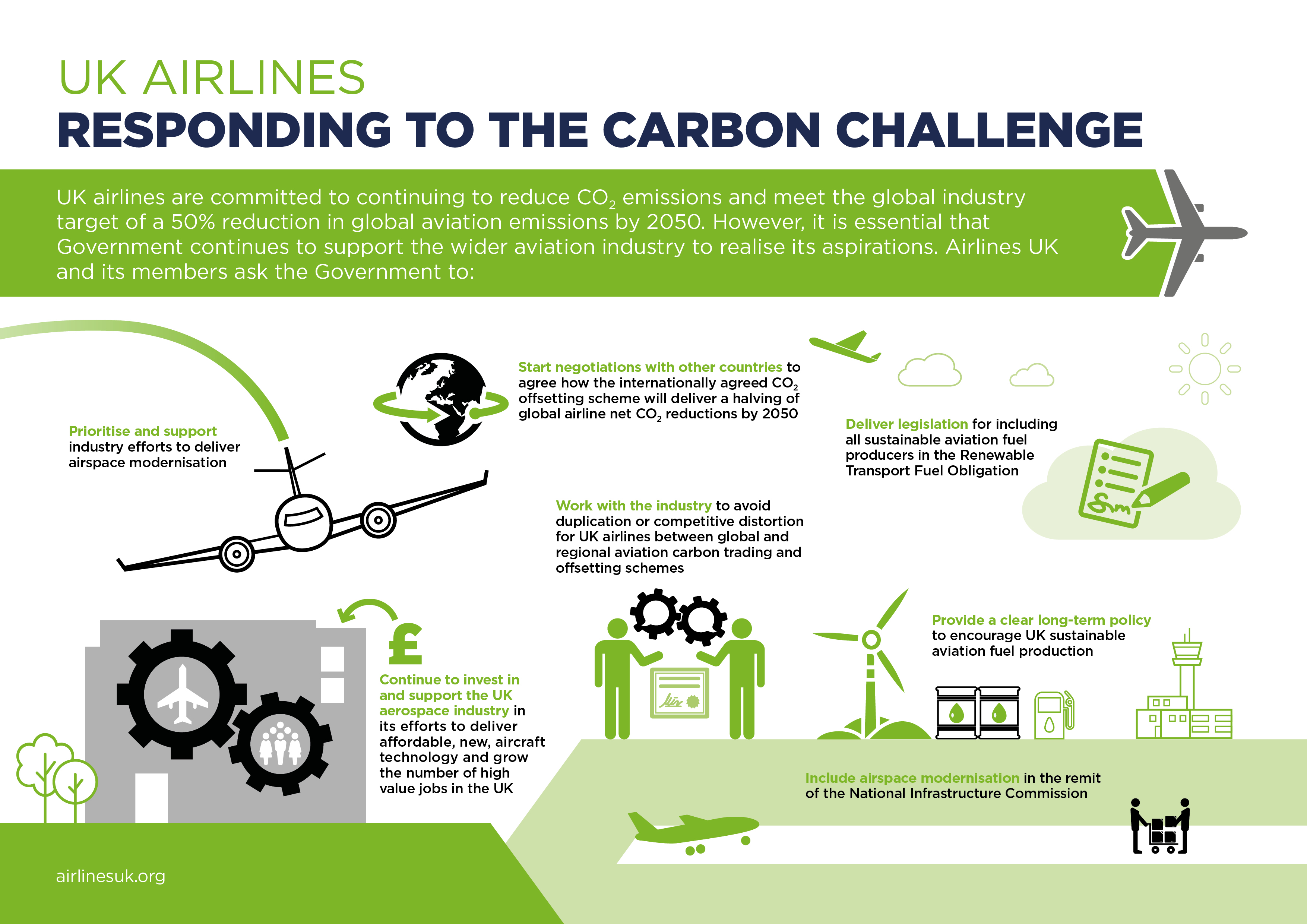
The Airlines UK report sets out a number of asks of the UK Government to help the aviation industry meet its aspirations of carbon reduction. These are:

  • Prioritise and support industry efforts to deliver airspace modernisation.
  • Include airspace, as a critical part of the UK national infrastructure which requires long-term strategic decision making, in the remit of the National Infrastructure Commission.
  • Deliver legislation for including all sustainable aviation fuel producers in the Renewable Transport Fuel Obligation.
  • Provide a clear long-term policy to encourage UK sustainable aviation fuel production.
  • Work with the industry to avoid duplication or competitive distortion for UK airlines between global and regional aviation carbon trading and offsetting schemes.
  • Start negotiations with other countries to agree how the new carbon offsetting and reduction scheme for international aviation will deliver a halving of global airline net CO2 reductions by 2050.
  • Continue to invest and support the UK aerospace industry to deliver affordable, new aircraft technology and grow the number of high value jobs in the UK.

airlines-uk-carbon_infographic_airlinecontribution_highresolutionairlines-uk-carbon_infographic_asks_highresolution  airlines-uk-carbon_infographic_report_highresolution

UK Airlines – Responding to the Carbon Challenge

A report by Airlines UK which sets out how the industry can meet the UK’s demand for air travel, while ensuring it limits its environmental impact and hits its stringent targets on reducing emissions.

UK Airlines – Responding to the Carbon Challenge

airlines-uk-carbon_infographic_airlinecontribution_highresolution

airlines-uk-carbon_infographic_asks_highresolution

airlines-uk-carbon_infographic_report_highresolution

UK airlines respond to Scottish Conservatives long-haul Air Passenger Duty pledge

Responding to the announcement from the Scottish Conservatives that they will support the removal of long-haul Air Passenger Duty from April 2018, Tim Alderslade, Chief Executive of Airlines UK, the trade association representing UK airlines, said:

“This is an important moment in the ongoing debate around APD, as it is clear that there is now cross-party support for reductions in the tax to take place in Scotland from April 2018.

“Airlines have long said that taking action on APD in Scotland will make a big difference to businesses and families – and we are pleased that the Scottish Conservatives have joined the SNP Government in acknowledging its damaging impact and paved the way for total abolition in the future.

“The two parties should use this announcement as a starting point for discussions – ahead of the Budget – so that reductions in the tax can take place in full, in 2018. Our view remains that action on long-haul APD must go hand-in-hand with action on domestic and European travel – so that all passengers can take advantage, irrespective of destination.”

Airlines UK responds to the Autumn Statement

Responding to the Autumn Statement delivered by the Chancellor earlier today, Tim Alderslade, Chief Executive of Airlines UK, the trade association representing UK airlines, said:

“The failure to take action on Air Passenger Duty is a missed opportunity to support family budgets and demonstrate that – in the current Brexit climate – the UK is open for business. It is increasingly untenable – at a time when we are looking to strike deals and open ourselves up to new markets and opportunities – for Ministers to continue to levy such excessively high levels of taxation on air travel. With new capacity at Heathrow not likely to be operational for another ten years at least, it was important for the Government to signal that improving connections from airports across the country and making the UK more competitive internationally is a top priority – and they failed in that task.  

“It is also extremely disappointing that the Government has failed to set out conclusively how they intend to respond to the Scottish Government reducing the tax by 50% in April 2018. It is still the policy of the Government to ensure that airports in England and elsewhere do not lose out by way of competitive distortion and yet by refusing to take a decision on any of the options currently under consideration until we leave the EU – whenever that may be – Ministers are prolonging the uncertainty that has built up over the past couple of years. The airline community was united in believing that none of the options were satisfactory – principally for the reason that all three would result in undue distortion of the market within England, with negative impacts for regional economies and consumers, and the summary of responses to the Treasury discussion paper published today makes clear that none of the options attracted support within industry. The fact that they have not been ruled out is a complete mystery, and begs the question of how the UK Government will respond once the APD cut north of the border takes place.”

ENDS

Joint statement between the UK Government and Airlines UK

A joint statement from the Secretary of State for Exiting the EU, the Secretary of State for Transport and the Chief Executive of Airlines UK – the association of UK airlines.

“Aviation is absolutely crucial to the UK’s economy and building a global Britain that seizes the opportunities exiting the EU presents.”

“As an island nation with global reach, we have the largest aviation network in Europe and the third largest in the world, handling over 250 million passengers and 2.3 million tonnes of cargo last year. The UK has direct connections to over 370 international destinations, more than any other EU country.”

“We will work closely together to ensure that this international industry continues to be a major success story for the UK economy – contributing around £20 billion in 2014 alone – and better understand what risks and opportunities exist. We also share a determination to give as much early certainty to the sector as possible, given the long lead in times associated with developing new routes – and to supporting the sector as much as possible in the interim.”

“Market access remains a top priority, and we want to make sure we have liberal access to European aviation markets. We will also work closely to explore new opportunities for further liberalisation. We are clear that Brexit provides greater freedom to seek new agreements between the UK and some third countries. This includes looking at possible bilateral agreements to strengthen economic and cultural ties even further with countries such as the US and Canada.”

“Other areas of critical importance to address during negotiations include aviation safety, security, air traffic management, passenger rights, customs, and the environment. We will continue to engage with the industry on these issues throughout.”

“We also share a determination to continue investment in the industry and to secure the best possible deal for UK aviation.”

“We want to work together to build on all this with a common aim to ensure that the industry – and therefore the country – remains prosperous and open for business.”


ENDS

Airlines urge the Government to use the Autumn Statement to remove Air Passenger Duty on air travel from UK airports.

UK and foreign airlines have urged the Government to use the upcoming Autumn Statement on 23 November to send a message to the world that the UK is open for business – post Brexit – by removing Air Passenger Duty on air travel from UK airports.

Airlines UK Chief Executive, Tim Alderslade, and Board of Airline Representatives in the UK Chief Executive, Dale Keller, said:

 “The UK’s airline organisations welcomed the announcement from the Government that approval would be granted to the building of an additional runway at Heathrow, but the truth is that this capacity will not be operational for another ten years at least. In the meantime there are airports across the UK with plenty of spare capacity, and the Government needs to do more to broaden their appeal to would-be airline customers. At the very top of the list of things they could prioritise – alongside improving surface connectivity – is dealing with APD.

“In the post-Brexit world, when we are looking to strike deals and see the UK become a standard-bearer of global free trade, it is becoming increasingly untenable for the Government to continue to levy excessively high levels of APD. Only aviation can connect the UK to the emerging markets that are seen as vital to our continued prosperity, and retaining an uncompetitive passenger tax is an open invitation to our international rivals to steal a march on us. Brexit has changed everything and we will not be able to take full advantage of the opportunities presented in terms of greater liberalisation unless action is taken now to become truly competitive.”   


ENDS