Why aviation matters blog series – The importance of air cargo by Zoe McLernon, Policy Manager at Logistics UK

Air freight is vital to the UK economy, contributing £7.2billion each year and supporting more than 151,000 jobs. The sector is extremely complex with both imports and exports that must be delivered safely, timely and economically. In this article, Zoe McLernon, Logistics UK’s Multimodal Policy Manager, explores the UK’s air freight industry and assesses its importance within the UK economy.

As well as its direct contribution, UK air freight holds importance across all sectors of the nation’s economy: £87.3 billion of UK Gross Value Added (GVA) is dependent on air freight exports annually, including £13.9 billion worth of pharmaceuticals. Salmon has become one of the UK’s most valuable food exports; in 2017, Scottish salmon exports were worth £600 million, growing year on year. And, while 91% of UK salmon is shipped internationally from Heathrow, increased connectivity at Scottish airports has provided exporters with alternative options, with salmon first exported on a direct flight from Edinburgh to Beijing in 2018.

Since the end of January 2020, hundreds of thousands of passenger flights have been cancelled in response to government travel restrictions across the globe to prevent the spread of COVID-19. With this, cargo capacity tailed off when it was needed desperately to transport vital medicines and medical equipment, such as PPE. In its place, fleets of freighter aircraft were mobilised to make up this capacity shortfall, and, thanks to the opportunities afforded by these aircraft, air cargo movements have now soared across the UK, with some airports reporting a 400% increase in cargo movements.

In my view, the COVID-19 outbreak is shining a light on the value of the logistics sector, particularly for those who rarely give our work a second thought, and provoking a re-evaluation of how much our economy relies on air cargo to keep our country moving. This can only be a positive thing for the future stability of our sector, at a time when many businesses are having to change the way they operate to move products and parts. That being said, aviation will take longer to recover than other modes and we must keep this at the forefront of our minds.

On the subject of Brexit, it is inevitable that the UK’s exit from the EU will affect the sector through changes to customs arrangements and air service agreements (ASAs). The UK currently has ASAs with the EU and other countries around the globe; differing depending on the country, the agreements recognise each other’s certification and approval processes. This is valid from the pilots that fly the planes, to the engineers and mechanics that work on the planes, right down to the fuel that keeps the planes flying. This agreement is still in place while we are in the Brexit transition period, however negotiations are still ongoing. It is vital that an ASA or comprehensive bilateral agreements are in place by 1 January 2021.

The continued growth of UK air freight is crucial to the overall UK economy and recovery for the sector is key, while considering the impact of EU Exit. Increasing international connectivity is a vital part of this; with more airports able to provide international freight flights, it will release much needed capacity at the current major freight airports. Moving forward, Logistics UK is calling on government to recognise air freight’s ongoing role in assisting with the response to the global pandemic, and ensure considerations are made for air cargo within aviation recovery plans.

Logistics UK (formerly FTA) is one of the UK’s leading business groups, representing logistics businesses which are vital to keeping the UK trading, and more than seven million people directly employed in the making, selling and moving of goods. With COVID-19, Brexit, new technology and other disruptive forces driving change in the way goods move across borders and through the supply chain, logistics has never been more important to UK plc. Logistics UK supports, shapes and stands up for safe and efficient logistics, and is the only business group which represents the whole industry, with members from the road, rail, sea and air industries, as well as the buyers of freight services such as retailers and manufacturers whose businesses depend on the efficient movement of goods. For more information about the organisation and its work, including its ground-breaking research into the impacts of COVID-19 on the whole supply chain, please visit logistics.org.uk

Why aviation matters blog series – The CBI’s Director of Infrastructure and Energy Tom Thackray on how aviation connects British business with the world

The aviation sector is vital to the wider UK economy and its recovery from the Coronavirus pandemic. As well as employing hundreds of thousands of staff, driving investment in cutting-edge technology, and underpinning vast domestic supply chains, UK aviation matters because it connects Britain with the world and links British products, experiences and expertise with billions of potential buyers overseas.

Businesses need flights to compete in a rapidly changing world economy. From professional services firms with clients in New York, to regional manufacturers who export to the UAE, British firms have built their business models on the assumption of easy access to growing markets. And while digital connectivity has enabled many parts of the economy to keep trading in the face of the pandemic, some things still need a human touch.

Nowhere is this more obvious than in the UK’s city centres, where luxury British brands have grown to cater for the spending habits of wealthy visitors from across Asia, North America, Europe, and the Middle East.  Before Coronavirus, the ease with which operators could connect global consumers with high quality British products and services meant that by 2017, 49% of the total value of UK exports outside of the EU travelled by air.[1] Until the pandemic hit, Heathrow was the country’s largest port by value of goods transited.[2]

Growing markets reached by aircraft will also be key to delivering new trading relationships with the world after Brexit. Like no other sector, aviation’s success stands behind aspirations for a Global Britain with brand power in markets with growing middle classes such as India, China, and Brazil. Increasing the UK’s share of exports to these markets will rely on air routes from regional centres as well as the London hubs. For instance, pre-pandemic, the Manchester-Beijing route had one of the highest load factors of any service launched between Europe and China, moving tourists, trade and investment into the North West.[3]

Most of all, as we recover from the economic shock from Coronavirus, businesses recognise the value of restoring UK connectivity with world markets. Rebuilding consumer confidence in flying in and out of the country will be essential for securing the commercial viability of routes connecting businesses with key trading partners. This will not only benefit carriers and their supply chain, supporting thousands of jobs in aviation and aerospace manufacturing, but crucially the wide range of firms that depend on the people and products that travel on these routes.

Central to this ambition will be establishing an affordable and internationally recognised testing regime that enables easy travel into and out of the country without the need for significant quarantine periods. The government’s planned test and release programme is a start, but to see the volume of travel needed to restart key routes, the UK will need to do more. In advance of the summer season, the business community needs testing systems developed that require minimal quarantine at borders and add very little to the cost of flying. This is achievable with political will combined with the innovation and investment of the private sector. Only then can aviation return to its key role helping firms connect and compete in a global market, ensuring Britain is back open for business.

[1] Steer, Assessment of the value of air freight services to the UK economy, October 2018, p.35.

[2] Centre for Economic and Business Research, February 2020.

[3] Manchester China Forum, The China Dividend – Two Years In, p.7.

Airlines UK and Airport Operators Association respond to the announcement of a ban on international leisure travel as a part of new lockdown measures

Responding to the announcement of a ban on international leisure travel as a part of new lockdown measures, Tim Alderslade, Chief Executive, Airlines UK and Karen Dee, Chief Executive of the Airport Operators Association said:

“This announcement is a 180-degree reversal of policy, since the Government added the Canaries to the travel corridors list just last week.

“Aviation has been devastated by the pandemic and has essentially never had the opportunity to recover. A ban on international travel means airlines and airports, already hamstrung by quarantine, are closed businesses and will require financial support now – which other sectors like hospitality have received – alongside a comprehensive restart package.

“This needs to include immediate additional economic support for the winter and steps to support recovery, including urgent roll-out of a testing regime, business rates relief for airports, and an emergency waiver of Air Passenger Duty that will be essential for enabling and stimulating international travel – absolutely vital for the UK economy – for as long as we are living with this virus. Hundreds of thousands of jobs and our economic recovery are on the line.”


UK airlines respond to arrivals testing announcement

Responding to the announcement made today by the Transport Secretary on arrivals testing, Tim Alderslade, Chief Executive of Airlines UK, the industry association representing UK-registered carriers, said:

 “That the Government is considering testing is a step forward but we need to see the detail. Ultimately we need to get to pre-departure testing for all arrivals in the UK – which is becoming the international norm – as soon as practically possible. Aviation is at a critical juncture and we have no time to lose, and we urge the Prime Minister to move quickly to get testing off the ground no later than the end of November so Britain does not lose further ground with its closest rivals.”


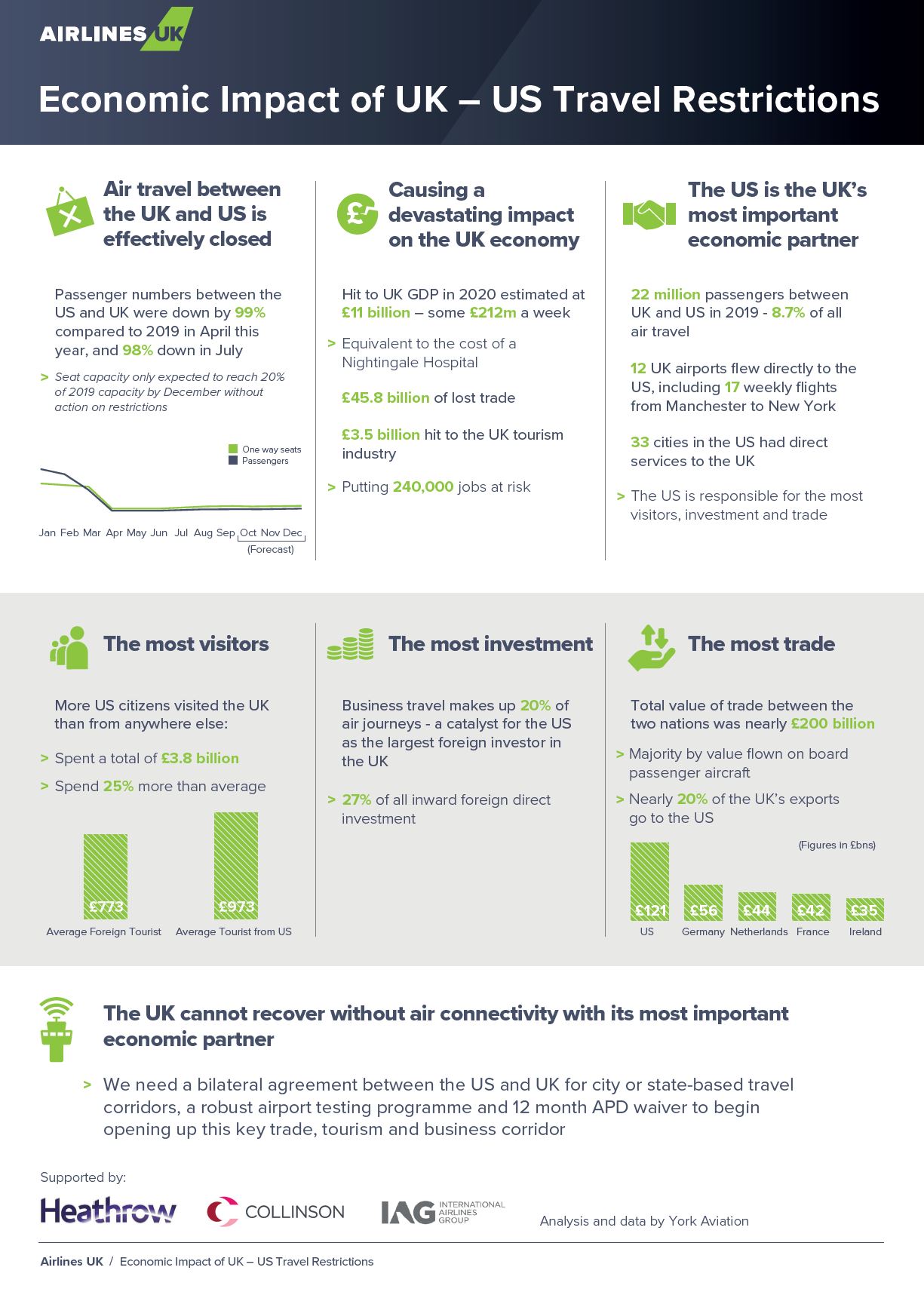
UK economy loses £32m every day as result of no airbridge with the US

  • New report details massive daily cost to the UK economy of lack of air link to the US
  • £121bn in UK exports and £417bn in Foreign Direct Investment at risk as air link remains closed between the UK and its most important trading partner
  • £3.5bn lost from US tourism and business travellers is revealed to be having a major impact on the restaurant, hospitality and retail sectors, impacting thousands of jobs
  • UK-wide issue, not just London and the South East, with 80 weekly flights between the US and six regional airports currently on ice
  • Report states the urgent need for bilateral agreement between the US and UK for city or state-based travel corridors and a robust airport testing programme to begin opening up this key trade, tourism and business corridor

A new report jointly commissioned by Airlines UK, International Airlines Group, Heathrow Airport and Collinson reveals the true economic and social impact of the closed borders between two of the world’s most critical trading partners. The report concludes that while the closed border has had a major impact on the aviation sector, the impact across the entire UK economy is devastating.

The impact of COVID-19 on the air transport market between the UK and the US has been dramatic and widely reported. As travel restrictions came into force in late March, seat capacity fell by around 92% compared to April 2019. In September, published seat capacity is around 85% down on 2019 and high capacity summer months have been lost.

The new joint report provides critical insight into the broader impact of the closed route between the US and the UK, revealing that the hit to UK GDP in 2020 is estimated to be at least £11 billion, with a significant proportion falling in Q4. By the beginning of October the closed air corridor between the US and the UK will be costing the UK economy £32m each and every day the air corridor remains closed.

John Holland Kaye, CEO of Heathrow Airport, said: “This is a stark warning that action is needed immediately to safely open up connections with our key trading partners in the US. We can start with flights to New York, a city where infection rates are now lower than here, and which is the UK’s most valuable route. PCR testing in private labs, both pre-flight and on arrival, would ensure that there is no risk of importing COVID and could pave the way to a Common International Standard for aviation testing.”

The UK sees more visitors by air from the US than from any other country, ordinarily welcoming nearly 4 million visitors each year – making the US the largest single source of inbound tourism and business travel to the UK economy. Visitors from the US spent a total of £3.8 billion during 2019, but this figure is expected to fall by £3.1 billion in 2020. Critically, the average duration of a trip by US visitors is seven days, meaning that current quarantine rules effectively lock these high-spending visitors out of the UK.

Alex Cruz, CEO of British Airways, said: “Government inaction on aviation and its impact on Britain’s economy couldn’t be clearer. Time is running out. Ministers must reach agreement with their US counterparts on a testing regime that minimises quarantine and permits regional travel corridors to re-open the UK-US market. They must learn from trials across the globe and start implementing new measures as soon as possible to return confidence in flying and protect thousands of jobs.”

While recognising that public health cannot be compromised, there is widespread industry and public frustration that blanket country-level travel restrictions are a blunt tool that unnecessarily sever economic ties when viable alternative policies like airport testing are available.

Airport-based COVID-19 testing has been embraced by more than 30 countries around the world and is now in use at more than half the world’s busiest airports including Paris Charles de Gaulle, Tokyo Haneda and Dubai International.

David Evans, Joint CEO of airport services company Collinson, said: “We’ve always known that travel brings an immeasurable value to economies as well as societies at large, but Covid-19 has put into perspective just how critical and quantifiable it is. Testing at the border has been extensively trialled internationally, in locations with very strong scientific oversight such as Germany and found to be a safe means to get the world travelling again. We have a ready-built facility at Heathrow as well as private testing and lab capacity that will not impact Government supplies in any way. All we need is the green light from Government.”

Tim Alderslade, CEO of Airlines UK, said: “The US is one of our most vital markets, worth tens of billions of pounds in trade every year, and millions of Americans come to the UK to visit and spend money in our shops, restaurants and tourist attractions. It’s critical we reopen this link, starting with the all-important London-New York route, so our economy and aviation sector can start the long road to recovery, and we urge Governments on both sides of the Atlantic to redouble their efforts to launch a testing regime as quickly as possible. In the absence of a vaccine, testing for arriving passengers – alongside regional travel corridors – remains the only way to resume international travel.”

Shai Weiss, CEO of Virgin Atlantic, said: “Our economic recovery will not take off without the free movement of people and goods. The closure of the US border since mid-March, coupled with the UK’s 14-day quarantine policy, effectively cuts us off from our most important economic partner. We need urgent government action now to introduce regional travel corridors for mainland US states, starting with New York and New Jersey where infection rates are lower than in the UK. 14 day quarantine must be replaced by a robust passenger testing regime for countries and regions where the risk is higher. More than 30 countries have already stolen a march and introduced passenger testing. If we don’t act now Britain will be left even further behind, putting many more thousands of jobs at risk across the country.”

Federation of Small Businesses (FSB) National Chair Mike Cherry, said: “The ties between the UK and US have long been crucial to the economies of both sides of the Atlantic, and now more than ever we’re seeing just how important those bonds are. Small businesses in parts of the country rely heavily on tourists visiting from the US, whether that be in cities like London or Edinburgh or in popular scenic areas right across the country. The past few months have been difficult for all businesses who have lost out on this crucial market.

“And for small firms waiting on the delivery of products to sell or as part of supply chains, it’s been an equally difficult time with factories forced to close or restrictions delaying manufacturing lines. The US is the number one target for small businesses looking to export, which is why we need to see these quarantine rules reviewed to help our ailing small firms both in the UK and the US.”

UK USA Travel Restrictions Impact Infographic

Immediate Action Required to Support UK Aviation – Letter to PM

The Rt Hon Boris Johnson MP
Prime Minister, First Lord of the Treasury and Minister for the Civil Service
10 Downing Street
London
SW1A 2AA

10 September 2020

Dear Prime Minister,

Immediate action required to support UK aviation

In July this year, we wrote to you as leaders in UK aviation to urge you to take immediate action to
support the future of our industry over the summer season, including with the development of
Covid-19 testing and targeted regional travel corridors.

The announcement this week of an “islands” policy with respect to travel quarantine is a welcome
step which may support the reopening of some international markets, but it is by no means enough
to support the sector and the world-beating connectivity it supports through what we know will be
the most challenging winter season we have ever faced.

Our industry is in crisis. This year we expect to carry passenger numbers not seen since the 1990s, a
simply unsustainable situation. A recovery to 2019 levels is not expected for at least four years and
as a result, UK airlines alone have announced or begun consulting on over 30,000 job losses. Many
thousands more are under threat across their supply chain. With 79% of international visitors to the
UK arriving by air, we play a vital role in supporting half a million jobs across leisure, retail,
hospitality and entertainment. Our cities, high streets and world class attractions will simply not
recover until they return. We are an island and there’s no option but to fly.

The summer season, where carriers make the bulk of their revenues and traditionally strengthen
their balance sheets, has been lost. We are now faced with a bleak winter period with no certainty
as to which markets we can operate to, depressed passenger demand, a Job Retention Scheme (JRS)
which is due to end in October, and the absence of a support package for aviation which other
countries across Europe – long ago – put in place for their own sectors.

Covid-19 testing is already being employed by over 30 countries and half the world’s busiest airports
as a safe and effective alternative to quarantine. It has the potential to be a hugely important tool
for authorities to safely open travel without quarantine from countries or regions deemed higher
risk, such as the United States and Canada. The UK is already falling well behind international rivals,
such as Germany, France and Iceland.

The aviation industry has been engaging with the Government on introducing testing of its own for
several months. The Transport Secretary told the House of Commons on Monday that he would
come back to the House over the “coming weeks” to set out further details, following continued
talks within Whitehall. Now is the time for action. We urge you to announce and implement a
policy on testing before the end of this month, and an expansion of regional travel corridors to
mainland areas. The stakes could not be higher. We risk economic ruin otherwise.

A Covid-19 PCR test following a 5-day quarantine on arrival into the UK offers a credible balance
between protecting public health and increasing demand for air travel. At the same time, the
Government should implement a trial – for example between London and New York – testing both on
arrival and at day 5, which would provide real-world data to give Ministers the reassurance that a
one-test on arrival system is safe.

Alongside testing, regional travel corridors will help to keep open markets that otherwise – through
a whole country approach – would remain closed. There are countless examples of countries
collecting data at a regionalised level which point to lower infection rates than in the country as a
whole. This more targeted approach to travel corridors will be vital to preserving what limited
connectivity we may have this winter.

We know this winter is going to be the toughest on record for the UK economy, and particularly the
aviation sector. We therefore believe a meaningful package of economic measures to support the
industry and save jobs is also required. Therefore, we ask for:

● An APD waiver for the next 12 months, which would protect regional connectivity, boost
passenger demand and protect 8,000 jobs.

● Extend the Job Retention or Skills Retention scheme for aviation, and key industries, that
continue to be impacted by Covid-19 restrictions. While helpful, the JRS is being wound
down at the exact time demand is expected to be depressed as markets are prevented from
opening because of travel restrictions.

● In addition, and as stated above, we request an immediate testing trial – for example from
London to New York – testing both on arrival and at day 5, to provide real-world data which
we hope will give Ministers the reassurance to move to a one-test on arrival system in
future. Alongside this and before the end of the month, a one-test testing system with the
test taking place no later than 5 days following arrival into the UK.

● A greater list of regional travel corridors beyond the ‘islands’ policy announced this week.
In sum, we ask you to act urgently to implement a programme of recovery for our sector. We also
ask you and your cabinet colleagues to consider these basic questions: do you want international
connectivity from the UK? Do you want the UK to remain the 3rd best connected country in the
world? Do you want to make Global Britain a reality rather than merely a slogan? If the answer to
any of these questions is “yes” then, before it is too late, you must grasp this last chance to save the
aviation industry, and with it so much prosperity across the UK.

Yours sincerely,

Tim Alderslade, Chief Executive, Airlines UK
Alex Cruz, Chief Executive, British Airways
Owain Jones, Managing Director, Wizz Air UK
Michael O’Leary, Chief Executive, Ryanair
Steve Heapy, Chief Executive, Jet2.com
Alastair Wilson, Managing Director, Titan Airways
Andy Offer, Director, 2Excel
Kenton Jarvis, CEO Aviation, Tui
Jonathan Hinkles, Chief Executive, Loganair
Andy Green, Chief Executive, Jota Aviation
Johan Lundgren, Chief Executive, easyJet
Tony Carder, Director of Civil Business, AirTanker
Shai Weiss, Chief Executive, Virgin Atlantic
Nadeem Saltan, Chief Executive, CargoLogicAir
Tony Burgess, Managing Director, Eastern Airways

UK airlines respond to introduction of “islands” policy on travel quarantine

Responding to the announcement made today by the Transport Secretary on an “islands” policy with respect to travel quarantine, Tim Alderslade, Chief Executive of Airlines UK, the industry association representing UK-registered carriers, said:

“This is a step in the right direction, which in time could help open up more markets for international travel and further choice and clarity for passengers. That said, a comprehensive testing regime is urgently required to enable connectivity to and from countries like the US, one of our most vital trading and strategic partners. The Transport Secretary has intimated that good progress is being made but it’s critical this is signed off by Government and implemented by the end of this month, and as carriers we will work with him on delivering the right solutions. As airlines enter what will be an incredibly tough winter period, further economic support for the industry, such as an APD waiver, must be considered in addition to these improved travel guidelines.”

Airlines UK reaction to France quarantine restrictions

Responding to the announcement that countries including France, Malta and the Netherlands have been added to the travel quarantine, Tim Alderslade, CEO of Airlines UK, the industry association representing UK-registered carriers, said:

“It’s another devastating blow to the travel industry already reeling from the worst crisis in its history. Having the political will to move to a sub-national approach to quarantine, in addition to a testing regime for arriving passengers so that those testing negative can avoid having to self isolate – which other countries like Germany have already implemented – is urgently needed to provide carriers and customers with additional certainty around the ability to operate this autumn and winter, avoiding broad-brush, weekly ‘stop and go’ changes to travel corridors at a national level, which have proven so disruptive to airlines and passengers alike.”

Emergency Air Passenger Duty waiver would save 45% of lost air routes and save 8,000 jobs, study concludes

An emergency 12-month Air Passenger Duty (APD) waiver would save 45% of the air routes out of the UK that would otherwise be lost due to the impacts of the Covid-19 pandemic, a new report has found. In addition, the support could potentially save 8,000 jobs and contribute an additional £7 billion in GVA.

The study carried out by York Aviation and commissioned by Airlines UK, the industry association for UK-registered airlines, shows:

  • Without intervention by the Government UK airports will lose around 600 routes initially, with the situation improving as the market recovers to being about 130 routes down by July 2021;
  • In 12 months’ time, around 80% of the lost routes will be in the UK regions;
  • With an emergency 12-month Air Passenger Duty waiver in place, the situation improves with the number of routes that would immediately return at around 35. This grows steadily as the market recovers, with an APD waiver supporting an additional 56 routes by July next year. In other words, by July 2021 it would have saved around 45% of routes that would otherwise be lost;
  • The APD waiver would boost passenger demand by around 12% over the next 12 months. This equates to around 21 million passengers over the 12 months against a baseline of 170 million passengers.
  • An APD waiver could potentially save 8,000 jobs over the next 12 months and enable the sector to support an additional £7 billion in GVA. This GVA saving is around 3.3 times greater than the expected revenue from APD over the next 12 months.

UK airlines are now asking for an emergency 12-month APD waiver to be announced no later than the autumn Budget to boost demand and enable the UK aviation industry to recover from the worst crisis in its history.

Tim Alderslade, CEO of Airlines UK, said: “UK airports are in danger of losing many valuable routes over the coming months unless the Government steps in with a support package for our sector – starting with an emergency APD waiver to get us through the winter and into the recovery. Some of these routes may never come back but APD relief will – by next July – save almost half that would otherwise be lost. The UK came into this crisis as the third best connected country in the world – it would be a tragedy if through Government inaction and neglect we needlessly forfeited this position to our closest rivals.”

Andrew Griffith, MP for Arundel and South Downs and former No 10 Business Adviser to the Prime Minister, said: “It’s never been more vital that Britain remains open for business. It would be disastrous for our regional and international airports to lose hundreds of routes to important global trading and tourism destinations. Whilst not the whole answer, if suspending the headwind of Air Passenger Tax can help get UK aviation – one of the jewels in our industrial crown – back on its feet sooner we would be remiss not to seriously consider it.”

Graham Brady, MP for Altrincham and Sale West and Chairman of the 1922 Committee, said: “We are in grave danger of causing real and lasting damage to UK aviation if measures are not taken to protect routes out of our airports and support the sector through what we know will be an extremely challenging winter. Almost alone within Europe we have been slow to appreciate the importance of aviation – not only as an industry that supports a million jobs – but as an enabler of the outward facing trading nation we wish to be.”

Notes:

  • The situation facing UK aviation remains highly precarious. Passenger demand is around 70% down in August 2020 compared to August 2019.
  • Over thirty thousand jobs have either been lost, are at risk or subject to consultation amongst UK airlines.
  • Airports, aerospace and ground handling businesses have also announced thousands of job cuts.
  • A report by the New Economic Foundation suggests that without additional government intervention the aviation industry and its supply chains could ultimately lose up to 124,000 jobs.
  • In 2021 global passenger demand is expected to be 32% lower than IATA’s October 2019 Air Passenger forecast for 2021.
  • Bookings for intra-EU routes are slowly increasing but are a long way from pre-crisis levels. Recovery is not yet in sight on extra-EU routes.
  • Data shows that the intra-EU market is slowly picking up following opening of borders on the 15 June, but as of 1 July remained 72% lower year on year compared to 2019.

Download the full report here:

UK airlines response to travel corridor countries announcement

Responding to the announcement by the Government on the countries with which the UK will open a travel corridor, Tim Alderslade, CEO of Airlines UK, the industry association representing UK-registered carriers, said:

“It’s a very welcome announcement and we’re pleased UK airlines will be able to re-start services to many key markets in time for peak summer travel. This gives a clear path to opening further predominantly long-haul destinations in the weeks ahead, and we look forward to working with Ministers on measures to mitigate the risk from red countries such as via voluntary testing.

“There’s no doubt quarantine has had a devastating impact on our industry and whilst it’s welcome the Government has removed its blanket ban we would encourage rigour and science is applied in all future decisions surrounding our businesses. Aviation is vital to our economy – and the huge increase in bookings over the past few days proves our customers are keen to get travelling again.”